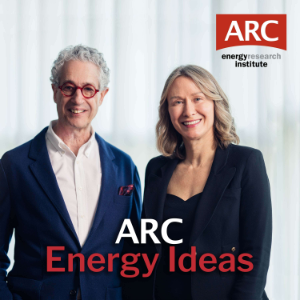
ARC ENERGY IDEAS
Business & Economics Podcasts
Join Peter Tertzakian and Jackie Forrest from the ARC Energy Research Institute as they explore trends that influence the energy business, including financial, political, environmental, technological, social and economic forces.
Location:
United States
Description:
Join Peter Tertzakian and Jackie Forrest from the ARC Energy Research Institute as they explore trends that influence the energy business, including financial, political, environmental, technological, social and economic forces.
Language:
English
Episodes
Shell, LNG Momentum, and Nova Scotia’s Energy Ambitions
4/28/2026
The podcast opens with major news: Shell’s agreement to acquire ARC Resources, signaling strong confidence in LNG Canada Phase 2, the broader Canadian LNG sector, and the quality of the Montney resource. It also marks a shift, as this is the first major multinational acquisition in Canada following a long period of exits.
Jackie and Peter discuss additional developments, including Minister Hodgson’s comments on major projects reaching FID or construction within a year and Prime Minister Carney’s announcement of a C$25 billion sovereign wealth fund. The episode then features the Honourable Tim Houston, Premier of Nova Scotia, who outlines Nova Scotia’s energy priorities, including offshore wind, oil and gas, and potential for onshore natural gas.
Jackie and Peter ask Premier Houston: How does the recent agreement with the federal government to streamline environmental reviews affect project timelines and certainty? What are the barriers to advancing the Wind West project? What factors led to the decline in offshore oil and gas production, and what actions are the province taking to support its revival? What is the opportunity for onshore natural gas in Nova Scotia, and what is the history of the 2014 hydraulic fracturing ban?
Content referenced in this podcast:
ARC Resources Announces Agreement to be Acquired by Shell PLC (April 27, 2026)Globe and Mail, “Slew of new major natural resource projects will be under way by next year, Hodgson predicts” (April 24, 2026)Prime Minister Carney announces the Canada Strong Fund – Canada’s first sovereign wealth fund (April 27, 2026)The Hub.ca, “Peter Tertzakian: Want to get pipelines built? Let Canadians own a piece of the action” (April 25, 2025)Nova Scotia Government Wind West Strategic PlanInformation on Nova Scotia’s recent call for bids process for offshore oil and gasNova Scotia onshore natural gas opportunityPlease review our disclaimer at: https://www.arcenergyinstitute.com/disclaimer/
Check us out on social media:
X (Twitter): @arcenergyinst
LinkedIn: @ARC Energy Research Institute
Subscribe to ARC Energy Ideas Podcast
Apple Podcasts
Amazon Music
Spotify
Duración:00:45:10
Stewart Muir on B.C. Energy: DRIPA, Pipelines, LNG & Power
4/21/2026
This week on the podcast, Peter and Jackie are joined by Stewart Muir, President and CEO of Resource Works, a leading voice in Canada’s natural resource sector with a focus on British Columbia.
Peter and Jackie open the episode with a discussion of the latest geopolitical developments, including escalating tensions involving Iran and the resulting volatility in oil prices over the weekend, as the Strait of Hormuz opened and then quickly closed. They also review the news of Prime Minister Mark Carney’s newly elected majority government, what it could mean for energy policy, and his recent video address, “Forward Guidance with Prime Minister Mark Carney.”
The conversation then shifts to British Columbia, where Stewart provides insight into the province’s current political landscape, starting with the controversy surrounding proposed changes to B.C.’s United Nations Declaration on the Rights of Indigenous Peoples Act (DRIPA) and Premier Eby's unexpected decision not to proceed with them.
Peter and Jackie also ask Stewart: Will the Major Project Office (MPO) help advance final investment decisions (FIDs) amid ongoing uncertainty around DRIPA? Is the B.C. government’s proposed royalty increase hurting the competitiveness of LNG projects and investment? Is there potential for B.C. to weaken its greenhouse gas policies to better align with federal-provincial agreements, including elements of the Alberta–Canada MOU? What is the current level of support for oil pipeline development in B.C., including among Premier Eby and Indigenous communities, particularly along the northern route? With B.C. increasingly importing electricity and facing potential supply shortages in the future, what are the options to expand generation capacity?
Content referenced in this podcast:
Forward Guidance with Prime Minister Mark CarneyPower Struggle Podcast with Stewart MuirFinancial Post Opinion by Deborah Yedlin: The world has an energy problem and Canada is the solutionPlease review our disclaimer at: https://www.arcenergyinstitute.com/disclaimer/
Check us out on social media:
X (Twitter): @arcenergyinst
LinkedIn: @ARC Energy Research Institute
Subscribe to ARC Energy Ideas Podcast
Apple Podcasts
Amazon Music
Spotify
Duración:00:47:42
Inside Suncor’s Transformation: A Conversation With Rich Kruger
4/15/2026
This week on the podcast, our guest is Rich Kruger, President and Chief Executive Officer of Suncor Energy Inc.
Rich explains key messages from the company's recent Investor Day presentation, including its transformation in safety, operations, and financial metrics over the past three years.
Here are some of the questions that Peter and Jackie asked Rich: What is Suncor’s production now, and what is your 3-year growth plan? How do oil sands costs stack up against U.S. shale? How much capital are you returning to shareholders, and how do you respond to criticism that Suncor should be investing more capital in Canada versus sending it to investors? What are the reserves of Suncor, and how do these compare to those of other companies? With pipeline proposals advancing west to tidewater and south to the United States, where should Canada focus its efforts? Are you concerned about Venezuela creating competition for Canadian oil in the United States? What are your thoughts on US shale oil? Do you expect the growth to slow? With active discussions underway on carbon pricing and the Pathways Carbon Capture project, what is your perspective on Canada’s future carbon policy and competitiveness? How does the federal government’s shift in tone affect your investment outlook, and does it meaningfully reduce greenfield project risk?
Content referenced in this podcast:
Suncor Investor Day replay and transcript (March 31, 2026)Please review our disclaimer at: https://www.arcenergyinstitute.com/disclaimer/
Check us out on social media:
X (Twitter): @arcenergyinst
LinkedIn: @ARC Energy Research Institute
Subscribe to ARC Energy Ideas Podcast
Apple Podcasts
Amazon Music
Spotify
Duración:00:49:56
Progress on the Canada-Alberta MOU: A Conversation with Deborah Yedlin
4/7/2026
This week on the podcast, we welcome back Deborah Yedlin, President and CEO of the Calgary Chamber of Commerce.
Deborah returned to the show to discuss the April 1 deadline for key deliverables under the Canada-Alberta Memorandum of Understanding (MOU), signed in late November 2025.
The conversation covered a wide range of topics, including:
Content referenced in this podcast:
Canada and Alberta MOU (November 27, 2025)Canada and Alberta reach agreement-in-principle on methane equivalency (March 25, 2026Canada and Alberta reach an agreement in principle to accelerate the construction of major projects in Alberta (March 6, 2026)Financial Post: Daniel Smith expects foreign investment to play a role in funding a new pipeline (March 3, 2026)Studio.Energy: The GDP Payoff of Additional Oil Pipeline Capacity (March 18, 2026)TC Energy President and CEO François Poirier: Canada can turn ambition into results, speech made at the Château Laurier (March 31, 2026)Studio.Energy: Beyond the Spike: What Oil Markets are Signaling (April 2, 2026)Please review our disclaimer at: https://www.arcenergyinstitute.com/disclaimer/
Check us out on social media:
X (Twitter): @arcenergyinst
LinkedIn: @ARC Energy Research Institute
Subscribe to ARC Energy Ideas Podcast
Apple Podcasts
Amazon Music
Spotify
Duración:00:41:37
Recapping CERAWeek 2026
3/31/2026
This week on the podcast, Jackie and Peter unpack key themes from the CERAWeek conference held in Houston from March 23–27, 2026.
Highlights from the conference include:
Canada is back on the global stage:Iran conflict and the Strait of Hormuz:U.S. energy dominance and permitting reform:Energy security for importers:AI and electricity demand:Quiet momentum in clean energy:
Content referenced on this podcast:
“Bottleneck to Breakthrough: A Permitting Blueprint to Build” (2025)NVIDIA and Emerald AI Join Leading Energy Companies to Pioneer Flexible AI Factories as Grid Assets (March 23, 2026)
Please review our disclaimer at: https://www.arcenergyinstitute.com/disclaimer/
Check us out on social media:
X (Twitter): @arcenergyinst
LinkedIn: @ARC Energy Research Institute
Subscribe to ARC Energy Ideas Podcast
Apple Podcasts
Amazon Music
Spotify
Duración:00:33:00
This Is Our Moment: An Interview With the Honourable Tim Hodgson
3/25/2026
This week, our guest is the Honourable Tim Hodgson, Canada’s Minister of Energy and Natural Resources. The conversation was recorded at CERAWeek in Houston on March 24, 2026.
Here are some of the questions Jackie asked Minister Hodgson: How is Canadian energy being perceived at CERAWeek, particularly in the context of the war in the Middle East? Do you expect that Canada will meet the Prime Minister’s targets of 50 million tonnes per annum of LNG exports by 2030 and potentially double that by 2040? What steps is Canada taking to attract the hundreds of billions in capital required to advance and build major projects, particularly amid strong competition from the United States? With the first deadline for the Alberta–Ottawa Memorandum of Understanding (MOU) just one week away, what progress has been made, and what are the prospects for advancing a 1 MMB/d oil pipeline to access Asian markets? Is Canada fiscally competitive, especially given its carbon pricing and policy framework compared to the United States? And finally, what opportunities lie ahead for Canada in electricity generation growth?
Please review our disclaimer at: https://www.arcenergyinstitute.com/disclaimer/
Check us out on social media:
X (Twitter): @arcenergyinst
LinkedIn: @ARC Energy Research Institute
Subscribe to ARC Energy Ideas Podcast
Apple Podcasts
Amazon Music
Spotify
Duración:00:31:37
What 1.5 Million Barrels per Day Could Mean for Canada’s Economy
3/17/2026
Over the past decade, the Canadian economy has been driven largely by consumption and government spending, while business investment has remained relatively flat. To accelerate Canada’s economic growth, an objective emphasized by Prime Minister Mark Carney, Canada will need stronger business investment, particularly investments with the “one-two punch” of growing the economy through increased capital spending in the early years and greater exports in the longer term.
To explore the historical drivers of GDP and what expanded export capacity could mean for Canada’s economy, Mark Parsons, Vice President and Chief Economist at ATB Financial, joins Jackie and Peter on the podcast. The discussion ends with answering the question: What would an additional 1.5 million barrels per day of oil pipeline export capacity, including a West Coast pipeline to Asia and other expansion projects, mean for Canada’s gross domestic product (GDP) growth and jobs outlook over the next decade?
Studio.Energy and ATB have collaborated on a series of reports examining Canada’s GDP and the potential economic impact of increased oil export capacity. The series also includes background articles explaining how GDP is calculated and historical trends.
These articles are available on both the Studio.Energy and ATB websites (see links below).
Content referenced in this podcast:
Peter Tertzakian’s op-ed in The Hub.ca: The next act in the oil crisis: Time to get ready for rationing and hoarding? (March 13, 2026)Seeking Shelter: Iran and the Next Structural Shift in Global Oil Markets (March 9, 2026)Canada’s Economy Under Siege (January 30, 2026)What is GDP, Really? (February 5, 2026)Canada’s GDP Dilemma: The Illusion of Growth (March 5, 2026)Special Reports | ATB FinancialProductive diversification: Maintaining Alberta’s productivity edge” (August 2024)Please review our disclaimer at: https://www.arcenergyinstitute.com/disclaimer/
Check us out on social media:
X (Twitter): @arcenergyinst
LinkedIn: @ARC Energy Research Institute
Subscribe to ARC Energy Ideas Podcast
Apple Podcasts
Amazon Music
Duración:00:45:54
Strait of Hormuz Closure and the Oil Price Roller Coaster
3/10/2026
This week on the podcast, Jackie and Peter review developments in the Iran war, which entered its tenth day at the time of recording on the morning of March 9, 2026.
The U.S. reports striking thousands of targets in Iran during the first week of the conflict and damaging or destroying more than 40 Iranian naval vessels. In response, Iran and the Islamic Revolutionary Guard Corps (IRGC) have launched missiles and drones across more than ten countries in the region.
Energy infrastructure across the Middle East has also been targeted, including facilities in Saudi Arabia, Qatar, Bahrain, Kuwait, the UAE, and Iran. Some regional producers have shut in oil production due to export disruptions, full storage tanks, and, in some cases, damaged facilities.
Tankers continue to avoid the Strait of Hormuz, a chokepoint through which roughly 20% of the world’s oil supply and LNG trade normally pass. The U.S. has offered naval escorts and a $20 billion tanker reinsurance program to restore shipping, but tankers are not moving yet. WTI briefly surged to about US$118 per barrel on March 9, before easing, amid reports that the G7 was considering releasing strategic petroleum reserves (SPR) and comments from the US President suggesting that the conflict could be nearing an end.
Jackie and Peter also explore potential winners from the crisis, including renewable energy and other alternatives, electric vehicles (EVs), Russia, and possibly Canada, particularly if Canada can expand market access and increase oil and gas production.
Content referenced in this podcast:
Financial Times: G7 discuss joint release of emergency oil reserves (March 9, 2026)Polymarket: US X Iran cease-fire by….CBC: Nervous nations calling Canada's energy minister after Iran strikes (March 3, 2026)Please review our disclaimer at: https://www.arcenergyinstitute.com/disclaimer/
Check us out on social media:
X (Twitter): @arcenergyinst
LinkedIn: @ARC Energy Research Institute
Subscribe to ARC Energy Ideas Podcast
Apple Podcasts
Amazon Music
Spotify
Duración:00:34:03
Iran War, Oil Prices, and Canada Implications
3/3/2026
On February 28, the United States and Israel launched an attack on Iran, killing the Supreme Leader along with other senior leaders of the Islamic Revolutionary Guard Corps (IRGC). In his initial statements following the attack, President Trump signaled that regime change was a potential objective.
Iran responded aggressively, targeting a range of military, civilian, and energy infrastructure across nine countries at the time of recording. Energy facilities have been hit, including a refinery in Saudi Arabia and LNG export facilities in Qatar. The Strait of Hormuz, a strategic chokepoint handling roughly one-fifth of global oil flows and a key corridor for Qatar’s LNG exports, is effectively blocked. Shipping companies and insurers are unwilling to risk moving through the narrow chokepoint amid ongoing missile and drone attacks in the region. Several tankers have also reportedly been struck.
As a result, oil and natural gas prices have risen. If the Strait of Hormuz remains blocked for an extended period, even higher prices are expected.
This week on the podcast, Peter and Jackie are joined by Josef Schachter, President and Founder of Schachter Energy Research Services Inc. They discuss the recent events, oil prices, available spare production capacity, and inventories, and what these developments could mean for the Canadian oil and gas industry.
Content referenced on this podcast:
Learn more about the Schachter Energy Report and the Eye on Energy ReportPlease review our disclaimer at: https://www.arcenergyinstitute.com/disclaimer/
Check us out on social media:
X (Twitter): @arcenergyinst
LinkedIn: @ARC Energy Research Institute
Subscribe to ARC Energy Ideas Podcast
Apple Podcasts
Amazon Music
Spotify
Duración:00:45:32
Building at Record Speed: Does Canada Have the Workforce?
2/24/2026
Prime Minister Mark Carney has said Canada needs to “build at speeds not seen in generations.” More than ten major projects have now been referred to the Major Projects Office (MPO). Assuming that all of the projects move forward in the next few years, will Canada have enough skilled workers to deliver them?
To explore this question, our guest this week is Sean Strickland, Executive Director of Canada’s Building Trades Unions. Canada’s Building Trades Unions is the voice of the country’s construction workers, representing more than 600,000 skilled tradespeople across Canada.
Here are some of the questions Jackie and Peter asked Sean: What is the current situation- do we have a shortage or an excess of trade workers? How might that change if all the projects being advanced by the Major Projects Office (MPO) move into construction over the next few years? How mobile is the labour force, and are there policy changes that could improve labour mobility? Are temporary foreign workers still available if Canadian labour becomes stretched thin? What are the demographics of the current workforce? What is it like to work on industrial projects in remote regions, including both the sacrifices and the rewards? How can workforce planning be done when the number of projects that will ultimately proceed remains highly uncertain?
Please review our disclaimer at: https://www.arcenergyinstitute.com/disclaimer/
Check us out on social media:
X (Twitter): @arcenergyinst
LinkedIn: @ARC Energy Research Institute
Subscribe to ARC Energy Ideas Podcast
Apple Podcasts
Amazon Music
Spotify
Duración:00:36:35
Edward Fishman on American Power in the Age of Economic Warfare
2/17/2026
This week on the podcast, we’re sharing highlights from a conversation at the 8th Annual Haskayne School of Business PETRONAS International Energy Speaker Series held on February 11, 2026.
Jackie Forrest moderated a sold-out session featuring award-winning author Edward Fishman, whose recent book Chokepoints: American Power in the Age of Economic Warfare, explores the rise of U.S. geoeconomic strategy. Mr. Fishman is a Senior Research Scholar at the Center on Global Energy Policy and an Adjunct Professor of International and Public Affairs at Columbia University.
Joining the discussion was Robert (RJ) Johnston, Director of Energy and Natural Resources Policy at the University of Calgary’s School of Public Policy.
The conversation explores a wide range of issues, including the United States’ use of tariffs as a tool of economic warfare, the potential for expanded investment and trade between Canada and China, how such a shift might be viewed by the U.S., and key lessons from American intervention in Venezuela. The panel also discusses the prospects for a peace agreement between Russia and Ukraine, whether a weakening U.S. dollar could diminish America’s ability to deploy economic statecraft, and, finally, whether China’s growing self-sufficiency could ultimately reduce the effectiveness of U.S. sanctions and leverage.
The episode concludes with Peter and Jackie sharing their reflections on the discussion, offering their own perspectives, and examining the issues through a Canadian lens.
Content referenced in this podcast:
“Oil, Mercantilism, and the Return of Gunboat Economics” (January 12, 2025)“Want to stop Trump bullying your country? Retaliate” (February 8, 2026)“The Cost of Being a Market Hostage,” (September 8, 2025)Please review our disclaimer at: https://www.arcenergyinstitute.com/disclaimer/
Check us out on social media:
X (Twitter): @arcenergyinst
LinkedIn: @ARC Energy Research Institute
Subscribe to ARC Energy Ideas Podcast
Apple Podcasts
Amazon Music
Spotify
Duración:00:47:21
Canada’s E-Fuels Competitiveness with StormFisher Hydrogen
2/10/2026
This week on the podcast, our guest is Brandon Moffatt, Chief Development Officer at StormFisher Hydrogen. StormFisher Hydrogen develops projects that repurpose energy, water, and power, with a focus on green hydrogen and e-fuels across the North American market. The company is currently advancing a low-carbon methanol project in Varennes, Quebec.
The conversation begins with an overview of green hydrogen–derived products, including e-methane, e-methanol, and green ammonia. Brandon explains why e-methanol is emerging as a leading end-use for green-hydrogen-derived fuels, particularly for marine shipping and aviation.
The discussion then turns to Canada’s competitive advantages in producing e-fuels, including access to low-carbon grid electricity in Quebec, Manitoba, and British Columbia, as well as the Canadian Investment Tax Credits (ITCs). With the United States rolling back support for green hydrogen in the One Big Beautiful Bill Act (OBBBA) last summer, Brandon notes that Canada currently holds a policy advantage in North America. However, global competition remains strong, particularly from India, China, and the Middle East, where cost structures are advantaged.
For Canada to remain globally competitive in green hydrogen-derived products, Brandon outlines several changes he believes are needed to Canada’s existing ITC framework. These include:
The episode concludes with a deeper dive into the Varennes project, including the potential for local job creation and the anticipated timing for a final investment decision and first production.
Content referenced in this podcast:
S&P Canadian Electric Car Insights to Q3 2025 (Dec 2025)StormFisher Hydrogen’s websiteLearn more about StormFisher’s low-carbon methanol project in Varennes, QuebecNote, the ARC Energy Funds are an investor in Storm Fisher Hydrogen. Please review our disclaimer at: https://www.arcenergyinstitute.com/disclaimer/
Check us out on social media:
X (Twitter): @arcenergyinst
LinkedIn: @ARC Energy Research Institute
Subscribe to ARC Energy Ideas Podcast
Apple Podcasts
Amazon Music
Spotify
Duración:00:42:21
Global Energy Transition Investment Hit a Record $2.3 Trillion in 2025
2/3/2026
This week on the podcast, Peter and Jackie review some of the latest developments in clean energy and the broader energy transition — including a discussion of terminology, with Peter advocating for a return to the older term “alternative energy”.
They begin by discussing Bloomberg New Energy Finance’s latest “Energy Transition Investment Trends (2026)”, which finds that global investment in the energy transition reached a record $2.3 trillion in 2025, up 8 % from 2024.
Next, they review a set of charts from a 200-slide deck released by Nat Bullard, an annual presentation on the state of decarbonization. Nat describes himself as a “climate-focused keynote speaker, board-level strategist, consultant, and advisor.” His side deck provides a comprehensive overview of the latest data across a wide range of energy types.
Finally, the hosts discuss a couple of new papers by Peter Tertzakian: one titled “Venezuela’s Fiscal Competitiveness” and another called “Oil, Mercantilism, and the Return of Gunboat Economics”. In this segment, they debate the impact of Venezuela’s high government take, which has contributed to declining production, and consider recent reforms to the country’s oil and gas sector aimed at attracting foreign investment.
Please review our disclaimer at: https://www.arcenergyinstitute.com/disclaimer/
Check us out on social media:
X (Twitter): @arcenergyinst
LinkedIn: @ARC Energy Research Institute
Subscribe to ARC Energy Ideas Podcast
Apple Podcasts
Amazon Music
Spotify
Duración:00:25:53
What Is Canadian Carbon Competitiveness?
1/27/2026
This week on the podcast, Jackie and Peter are joined by Marcus Rocque, Vice President of Research at the ARC Energy Research Institute. This episode focuses on Canadian federal carbon policy, including a discussion of the carbon pricing policy for large industrial emitters and the recently finalized methane regulations, which target a 75% reduction by 2030 (relative to 2012). The discussion centers on how these policies affect competitiveness, investment, and infrastructure development in Canada's natural gas and oil sector.
They start by discussing Prime Minister Carney’s recent speech at Davos. Next, they review recent developments in Canadian carbon policy, including the Canada–Alberta Memorandum of Understanding (MOU) signed on November 27, 2025, in which both governments agreed to work toward an oil pipeline to reach Asian markets. The MOU also outlines a plan to develop a revised industrial carbon pricing policy and methane regulations by April 1, 2026. Not long after the MOU was signed, in December 2025, Environment and Climate Change Canada (ECCC), a federal agency, issued final methane regulations that conflict with the MOU, with one requiring an end date of 2030 and the other 2035. Further to this, ECCC released a discussion paper in December titled “Driving Effective Carbon Markets in Canada”, asking for feedback by January 30, 2026, on potential changes to Canada’s carbon markets, which are also being modified as part of the Canada-Alberta MOU by April 1.
Jackie, Peter, and Marcus discuss what “carbon competitiveness” means and how Canadians should think about it in a changing global energy landscape. They also share concerns about the carbon market discussion paper and new methane regulations.
Content referenced on this podcast:
Discussion Paper: Driving Effective Carbon Markets in CanadaSend your feedback to ECCC before January 30, 2026,tarificationducarbone-carbonpricing@ec.gc.caFinal Methane Regulations: Canada Gazette, Part II, Volume 159, Number 27Please review our disclaimer at: https://www.arcenergyinstitute.com/disclaimer/
Check us out on social media:
X (Twitter): @arcenergyinst
LinkedIn: @ARC Energy Research Institute
Subscribe to ARC Energy Ideas Podcast
Apple Podcasts
Amazon Music
Spotify
Duración:00:42:26
Rob West’s Top Energy Themes for 2026 + Your Doomsday Power Backup Plan
1/20/2026
This week on the podcast, we welcome back Rob West, founder and CEO of Thunder Said Energy. Founded in 2019, the firm provides research that helps decision-makers identify energy opportunities. Based in Estonia, nine time zones away, Rob is an exceptionally productive energy expert whose work spans a wide range of topics.
We begin by walking through Rob’s Top Ten Themes for Energy in 2026, including the continued steady growth in global oil demand, a waning focus on net zero, EVs, and decarbonization. With that lens, we also discuss Canada’s Pathways carbon capture and storage (CCS) project. Rob then shares his bullish outlook for LNG demand growth, with positive implications for Canada’s aspiration to grow LNG exports. Rob also argues that there is a growing investment case for grid-enhancing technologies to increase the utilization of existing infrastructure and meet rising electricity loads. We also touch on the outlook for copper demand driven by electrification, robotics, and AI data centers, as well as Rob’s expectations for electricity load growth, which are more conservative than some other forecasts.
Finally, Rob and Jackie revisit Jackie’s “doomsday” scenario: what it would actually cost to back up her home during an extended power outage, comparing options such as using stored power from an electric vehicle, a home battery, and a natural gas generator.
Content referenced on this podcast:
https://thundersaidenergy.com/Ten Themes for Energy in 2026 from Thunder Said Energy (January 1, 2026)Rob’s video: US load growth: unpopular opinions (September 3, 2025)Please review our disclaimer at: https://www.arcenergyinstitute.com/disclaimer/
Check us out on social media:
X (Twitter): @arcenergyinst
LinkedIn: @ARC Energy Research Institute
Subscribe to ARC Energy Ideas Podcast
Apple Podcasts
Amazon Music
Spotify
Duración:00:43:04
Predicting the Unpredictable: Energy and Geopolitics in 2026
1/13/2026
Predicting the Unpredictable: Energy and Geopolitics in 2026
This week, Peter and Jackie kick off the year with their 2026 outlook. They begin by asking a fundamental question: How relevant are predictions in an increasingly unpredictable world?
While acknowledging the limits of forecasting, they outline key themes and directional expectations for 2026—and remind leaders that, in times like these, scenario development, continuous monitoring, and course correction are far more valuable than rigid forecasts.
The discussion focuses on four major areas shaping the outlook for Canadian energy, spanning oil and gas and clean energy technologies:
Global geopolitics and energy markets:Oil and gas fundamentals:Technology and disruption:Canada’s unique circumstances:While predicting the future may be difficult, one thing Jackie and Peter are confident about is that the ARC Energy Ideas podcast will be here throughout the year—helping you navigate what is shaping up to be a consequential and eventful year for energy markets and geopolitics.
Please review our disclaimer at: https://www.arcenergyinstitute.com/disclaimer/
Check us out on social media:
X (Twitter): @arcenergyinst
LinkedIn: @ARC Energy Research Institute
Subscribe to ARC Energy Ideas Podcast
Apple Podcasts
Amazon Music
Spotify
Duración:00:44:45
Special Episode: U.S. Intervention in Venezuela and What It Means for Canada
1/9/2026
This special episode analyzes the United States’ intervention in Venezuela on January 3, 2026, and explores its broader implications for Canada and the Canadian oil sector.
Peter and Jackie open with a discussion of the geopolitical backdrop and the range of narratives circulating about the U.S. motivations for seizing and arresting Venezuelan President Nicolás Maduro and his wife, including efforts to curb drug trafficking and illegal migration, and to counter the growing influence of China, Russia, and terrorist groups in the country. They also reference the U.S. National Security Strategy released in November 2025, which calls for a Western Hemisphere free from hostile foreign control and signals renewed enforcement of a “Trump Corollary” to the Monroe Doctrine.
The Monroe Doctrine is a foundational principle of U.S. foreign policy, first announced in 1823, that set out the United States' view of the Western Hemisphere. General principles at the time held that European powers should no longer interfere in the Americas and that the Western Hemisphere was now the U.S. sphere of influence.
Peter and Jackie then turn to the oil market implications for Canadian oil. If sanctions on Venezuela were eased, increased Venezuelan heavy oil exports to the U.S. could intensify competition for Canadian oil on the U.S. Gulf Coast, which accounts for about 10% of Canada’s crude oil exports. The exports to Canada’s largest market, the U.S. Midwest, which makes up 70% of all exports, are more insulated.
The discussion concludes with an assessment of potential Venezuelan production scenarios, including the possibility of declining output, a pattern that has frequently followed similar government changes in the past. They conclude that, in any scenario, a clear takeaway for Canada is that building additional West Coast pipelines is critical. Diversifying export markets, strengthening economic resilience, and improving national sovereignty and autonomy are imperatives for Canada.
Please review our disclaimer at: https://www.arcenergyinstitute.com/disclaimer/
Check us out on social media:
X (Twitter): @arcenergyinst
LinkedIn: @ARC Energy Research Institute
Subscribe to ARC Energy Ideas Podcast
Apple Podcasts
Amazon Music
Spotify
Duración:00:36:28
2025 Wrap-Up: Energy, Policy, and Predictions Revisited
12/16/2025
We’re closing out the year with our final podcast of 2025, looking back at the biggest stories and revisiting the predictions we made at the start of the year. How did we do?
2025 delivered volatility and plenty of surprises, along with a long list of developments with real consequences for energy, both clean energy and traditional oil and gas. We cover major policy shifts, including the election of the Mark Carney Liberals in Canada, the introduction of Bill C-5, the launch of the Major Projects Office, the Ottawa–Alberta Memorandum of Understanding (MOU), and growing political support for LNG.
We also review changes in the United States, including tariffs and the One Big Beautiful Bill (OBBB), which rolled back many of America’s generous clean energy subsidies.
Another recurring theme this year was the surge in expectations for AI data center electricity demand—including in Canada, where three proposed projects in Alberta are moving closer to a final investment decision.
It’s been a whirlwind year. Jackie and Peter wish everyone a wonderful holiday break, and we’ll return in 2026.
Content referenced in this podcast:
The Hub.ca, Have we really hit peak oil? Please don’t count on it (December 2, 2025)National Security Strategy of the United States of America (November 2025)Please review our disclaimer at: https://www.arcenergyinstitute.com/disclaimer/
Check us out on social media:
X (Twitter): @arcenergyinst
LinkedIn: @ARC Energy Research Institute
Subscribe to ARC Energy Ideas Podcast
Apple Podcasts
Amazon Music
Spotify
Duración:00:40:14
First Cargo, Future Opportunities: A Conversation with LNG Canada CEO Chris Cooper
12/9/2025
Canada’s first cargo of LNG set sail from Kitimat, British Columbia, on June 30, 2025. This week on the podcast, Chris Cooper, President and CEO of LNG Canada, joins us to reflect on that milestone, walk through the project’s progress, and share his view of Canada’s long-term LNG opportunity.
Jackie and Peter asked Chris a wide-ranging set of questions, including: What was going through your mind as the first carrier departed? What does the workforce on-site look like today, and are workers living locally or in camps? What are the practical logistics of bringing LNG tankers in and out of the facility and navigating the Douglas Channel? Is the plant operating at full capacity yet? How would you characterize the current level of support from the B.C. provincial government? How significant was Prime Minister Mark Carney’s trip to Asia to sell Canada’s potential for LNG growth, and what did it mean to see LNG Canada Phase 2 included among the projects that were referred to the Major Projects Office? Finally, how does Canadian LNG stack up against other global supply sources, and what do you see as the outlook for worldwide LNG demand?
Content referenced in this podcast:
Steven Guilbeault Speaks to CTV’s Power Play with Vassy Kapelos (December 4, 2025)Clean Prosperity study that the Federal-Alberta MOU can unlock $90 billion in low-carbon investment if governments follow through (December 4, 2025)Photos of the LNG Canada work camp at Cedar Valley LodgeShell LNG Outlook 2025Please review our disclaimer at: https://www.arcenergyinstitute.com/disclaimer/
Check us out on social media:
X (Twitter): @arcenergyinst
LinkedIn: @ARC Energy Research Institute
Subscribe to ARC Energy Ideas Podcast
Apple Podcasts
Amazon Music
Spotify
Duración:00:47:17
Alberta–Ottawa’s MOU: Reactions, Reality, and National Opportunity
12/2/2025
A memorandum of understanding (MOU) between Alberta and the Canadian federal government was signed on November 27, 2025. It declared a shared goal of making Canada a global energy superpower by building one or more privately financed oil pipelines, co-owned with Indigenous Peoples, to ship at least 1 million barrels per day of low-emission Alberta bitumen, prioritizing routes to Asian markets, and submitting an application to the Major Projects Office by July 1.
Building the pipeline requires building the large-scale oil sands Pathways carbon capture and storage (CCS) project. Alberta and the federal government will also engage with the Government of British Columbia on the pipeline initiative.
Among other commitments, the MOU pledges to suspend the Canadian Electricity Regulations (CER) as they apply to Alberta and to scrap the proposed nationwide oil and gas emissions cap for producers. Further details are expected to be finalized by April 1.
To unpack this tectonic shift in Alberta–Ottawa relations—along with the first wave of media coverage and the deal’s potential benefits for Canada —Peter and Jackie are joined by guest Deborah Yedlin, President and CEO of the Calgary Chamber of Commerce.
Content referenced in this podcast:
Canada-Alberta Memorandum of Understanding (November 27, 2025)Angus Reid Institute Polling on Support and Opposition for Alberta-BC Pipeline (November 27, 2025)CBC At Issues Panel on Carney’s Alberta Pipeline Partnership (November 28, 2025)Please review our disclaimer at: https://www.arcenergyinstitute.com/disclaimer/
Check us out on social media:
X (Twitter): @arcenergyinst
LinkedIn: @ARC Energy Research Institute
Subscribe to ARC Energy Ideas Podcast
Apple Podcasts
Amazon Music
Spotify
Duración:00:47:16