
Premium
Anshuman Mishra
6/1/2025
Published by Anshuman Mishra, 2025.
6/1/2025
PART 1: FOUNDATIONS OF NATURAL LANGUAGE PROCESSING
6/1/2025
PART 2: CLASSICAL NLP TECHNIQUES
6/1/2025
PART 3: MACHINE LEARNING FOR NLP
6/1/2025
PART 4: ADVANCED NLP WITH DEEP LEARNING
6/1/2025
PART 5: APPLICATIONS OF NLP
6/1/2025
PART 6: NLP PROJECTS AND FUTURE TRENDS
6/1/2025
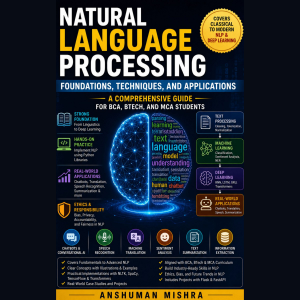
Book Title:
6/1/2025
About the Book:
6/1/2025
Benefits of Studying This Book:
6/1/2025
1.1 Definition and Scope of NLP | Definition of NLP
6/1/2025
1.2 History and Evolution of NLP
6/1/2025
1.3 Applications in Real-World Scenarios
6/1/2025
2.1 Syntax, Semantics, and Pragmatics
6/1/2025
2.2 Morphology and Parts of Speech (POS)
6/1/2025
2.3 Sentence Structure and Parsing
6/1/2025
Text Processing and Preprocessing
6/1/2025
3.1 Tokenization and Sentence Segmentation
6/1/2025
3.2 Stopword Removal and Lemmatization
6/1/2025
3.3 Stemming and Word Normalization
6/1/2025
3.4 Handling Noisy and Unstructured Text
6/1/2025
4.1 Pattern Matching in Text
6/1/2025
4.2 Named Entity Recognition (NER)
6/1/2025
4.3 Using Regex in Python for NLP
6/1/2025
5.1 Bag of Words (BoW) Model
6/1/2025
5.2 Term Frequency-Inverse Document Frequency (TF-IDF)
6/1/2025
5.3 Word Embeddings and Vector Representations
6/1/2025
6.1 Rule-Based vs Statistical POS Tagging
6/1/2025
6.2 Dependency Parsing
6/1/2025
6.3 Constituency Parsing
6/1/2025
7.1 Supervised vs Unsupervised Learning in NLP
6/1/2025
7.3 Evaluation Metrics for NLP Models
6/1/2025
8.1 Introduction to Text Classification
6/1/2025
8.2 Naïve Bayes Classifier
6/1/2025
8.3 Logistic Regression for Text Classification
6/1/2025
8.4 Sentiment Analysis Applications
6/1/2025
9.1 Named Entity Recognition (NER)
6/1/2025
9.2 Relation Extraction and Coreference Resolution
6/1/2025
9.3 Applications of NER and Information Extraction
6/1/2025
10.1 Word Embeddings: Word2Vec, GloVe, and FastText | What are Word Embeddings?
6/1/2025
10.1.1 Word2Vec
6/1/2025
10.1.2 GloVe (Global Vectors for Word Representation)
6/1/2025
10.1.3 FastText
6/1/2025
10.2 Contextual Embeddings: ELMo and BERT
6/1/2025
10.2.1 ELMo (Embeddings from Language Models)
6/1/2025
10.2.2 BERT (Bidirectional Encoder Representations from Transformers)
6/1/2025
10.3 Applications of Word Embeddings and Contextual Representations
6/1/2025
11.1 Introduction to Sequence Modeling
6/1/2025
11.2 Understanding Recurrent Neural Networks (RNNs)
6/1/2025
11.3 LSTMs and GRUs for Text Processing
6/1/2025
What is Attention?
6/1/2025
Key Idea
6/1/2025
12.1.1 Types of Attention Mechanisms
6/1/2025
12.1.2 Self-Attention Mechanism
6/1/2025
12.2 The Transformer Architecture
6/1/2025
12.2.3 Transformer Implementation in Python
6/1/2025
12.3 BERT, GPT, and T5 for NLP | 12.3.1 BERT (Bidirectional Encoder Representations from Transformers)
6/1/2025
12.3.2 GPT (Generative Pre-trained Transformer)
6/1/2025
12.3.3 T5 (Text-to-Text Transfer Transformer)
6/1/2025
12.4 Applications of Transformers in NLP
6/1/2025
13.1 Sequence-to-Sequence Models
6/1/2025
13.2 Autoencoders for Text Generation | What is an Autoencoder?
6/1/2025
13.3 Extractive vs Abstractive Summarization
6/1/2025
13.4 Applications of Text Generation and Summarization
6/1/2025
14.1 Rule-Based vs AI-Powered Chatbots
6/1/2025
14.1.2 AI-Powered Chatbots
6/1/2025
14.2 Building a Simple Chatbot Using NLP
6/1/2025
14.2.1 Steps to Build an NLP Chatbot
6/1/2025
14.2.2 Chatbot with Machine Learning
6/1/2025
14.3 Case Studies: Siri, Alexa, and Google Assistant
6/1/2025
14.3.1 Siri (Apple)
6/1/2025
14.3.2 Alexa (Amazon)
6/1/2025
14.3.3 Google Assistant
6/1/2025
14.4 Applications of Chatbots and Conversational AI
6/1/2025
15.1 Basics of Speech Processing
6/1/2025
15.1.2 Key Concepts in Speech Processing
6/1/2025
15.2 Hidden Markov Models (HMM) for Speech Recognition
6/1/2025
15.3 Neural TTS Models
6/1/2025
15.4 Applications of Speech Recognition and TTS
6/1/2025
16.1 Classical Approaches vs Neural Machine Translation (NMT)
6/1/2025
16.1.2 Neural Machine Translation (NMT)
6/1/2025
16.2 Introduction to Google Translate and OpenNMT | 16.2.1 Google Translate: A Large-Scale NMT System
6/1/2025
16.2.2 OpenNMT: An Open-Source NMT Framework
6/1/2025
16.3 Applications of Machine Translation and Cross-Language NLP
6/1/2025
17.1 Building a Sentiment Analysis System
6/1/2025
17.2 Implementing a Text Summarization Tool
6/1/2025
17.3 Deploying NLP Models with Flask and FastAPI
6/1/2025
17.4 Applications of Real-World NLP Models
6/1/2025
18.1 Bias in Language Models | 18.1.1 What is Bias in NLP?
6/1/2025
18.1.3 How Bias is Introduced?
6/1/2025
18.1.4 Mitigating Bias in NLP Models
6/1/2025
18.2 Privacy and Security in NLP Applications
6/1/2025
18.3 Fairness and Ethical Use of NLP
6/1/2025
18.4 Case Studies of Ethical Concerns in NLP
6/1/2025
18.5 Future of Ethical NLP Development
6/1/2025
19.1 Multimodal NLP | 19.1.1 What is Multimodal NLP?
6/1/2025
19.2 Explainability in NLP Models | 19.2.1 Why is Explainability Important?
6/1/2025
19.2.3 Challenges in Explainable NLP
6/1/2025
19.3 Low-Resource Language Processing
6/1/2025
19.4 The Future of NLP
6/1/2025