
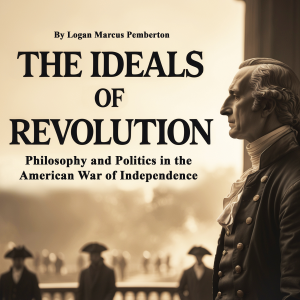
The Ideals of Revolution
Logan Marcus Pemberton
This audiobook is narrated by a digital voice.
The American Revolution was not merely a military conflict fought over taxation and representation, but a profound philosophical transformation that challenged the very foundations of political authority...
Location:
United States
Networks:
Logan Marcus Pemberton
Digital Voice Matt G
Sally Stephens LLC
English Audiobooks
INAudio Audiobooks
Description:
This audiobook is narrated by a digital voice. The American Revolution was not merely a military conflict fought over taxation and representation, but a profound philosophical transformation that challenged the very foundations of political authority in the Western world. To understand the revolutionary fervor that swept through the thirteen colonies in the 1760s and 1770s, we must first examine the intellectual currents that shaped colonial thinking about government, liberty, and the relationship between ruler and ruled. The colonists did not arrive at their revolutionary conclusions in isolation. They were inheritors of a rich tradition of political philosophy that stretched back through the English Civil War, the Glorious Revolution of 1688, and the broader Enlightenment movement that was reshaping European thought. The works of John Locke, particularly his Second Treatise of Government, provided the theoretical framework that would justify resistance to British rule. Locke's argument that governments derive their authority from the consent of the governed, and that people possess natural rights to life, liberty, and property that no government may justly violate, became central to American political thought. Yet the colonists were not merely passive recipients of European ideas. They adapted and transformed these concepts to fit their particular circumstances, creating something genuinely new in the process. The experience of living in a frontier society, where traditional hierarchies were less rigid and individual initiative was highly valued, shaped how Americans understood concepts like liberty and equality. The relatively egalitarian nature of colonial society, particularly in New England, provided fertile ground for democratic ideas that would have seemed radical in the more stratified societies of Europe. Duration - 42m. Author - Logan Marcus Pemberton. Narrator - Digital Voice Matt G. Published Date - Monday, 20 January 2025. Copyright - © 2025 Logan Marcus Pemberton ©.
Language:
English
Start
Duration:00:42:11