
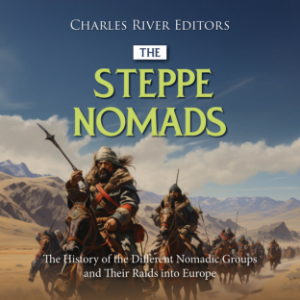
The Steppe Nomads: The History of the Different Nomadic Groups and Their Raids into Europe
Charles River Editors
Though history is usually written by the victors, the lack of a particularly strong writing tradition from the Mongols ensured that history was largely written by those who they vanquished. Because of this, their portrayal in the West and the Middle...
Location:
United States
Description:
Though history is usually written by the victors, the lack of a particularly strong writing tradition from the Mongols ensured that history was largely written by those who they vanquished. Because of this, their portrayal in the West and the Middle East has been extraordinarily (and in many ways unfairly) negative for centuries, at least until recent revisions to the historical record. The Mongols have long been depicted as wild horse-archers galloping out of the dawn to rape, pillage, murder and enslave, but the Mongol army was a highly sophisticated, minutely organized and incredibly adaptive and innovative institution, as witnessed by the fact that it was successful in conquering enemies who employed completely different weaponry and different styles of fighting, from Chinese armored infantry to Middle Eastern camel cavalry and Western knights and men-at-arms. Geographically the Tatars descend from several parts of Asia, particularly Central Asia, but the Crimean region has been the nexus of several great power rivalries and numerous conflicts. Yet the Crimean Tatars endured through many of these, aligning themselves with a number of larger powers and developing a reputation as fearsome warriors. Today the Tatars are mainly linked with and live in the Volga region of the Russian Federation. Indeed, Tatarstan is a republic in modern Russia. The “Volga Tatars” are perhaps the best known of the peoples known as Tatars and today number about 5 million people. Before the Mongols rode across the steppes of Asia and Eastern Europe, the Cumans were a major military and cultural force that monarchs from China to Hungary and from Russia to the Byzantine Empire faced, often losing armies and cities in the process. The Cumans were a tribe of Turkic nomads who rode the steppes looking for plunder and riches, but they rarely stayed long after they got what they wanted. Duration - 6h 42m. Author - Charles River Editors. Narrator - Bill Caufield. Published Date - Friday, 26 January 2024. Copyright - © 2023 Charles River Editors ©.
Language:
English
Opening Credits
Duration:00:00:10
Introduction
Duration:00:11:43
Uniting the mongols
Duration:00:31:31
The origins of the golden horde
Duration:00:22:39
The horde under uzbeg
Duration:00:14:30
The decline of the horde
Duration:00:35:09
The khanate of kazan
Duration:00:08:23
Crimean tatars
Duration:00:14:43
The ottoman empire
Duration:00:31:19
Tatars in the 20th century
Duration:00:16:02
The origins of the avars
Duration:00:35:52
The avars' culture
Duration:00:17:02
The late avar period
Duration:00:14:11
The magyars' origins
Duration:00:13:45
The invasions of europe
Duration:00:22:27
A steppe empire
Duration:00:27:05
The arpad dynasty
Duration:00:41:32
The cumans in hungary and byzantium
Duration:00:30:43
The cumans and the mongols
Duration:00:13:06
Ending Credits
Duration:00:00:12