
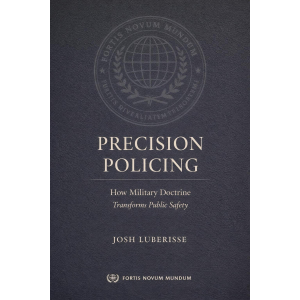
Precision Policing: How Military Doctrine Transforms Public Safety
Josh Luberisse
This audiobook is narrated by a digital voice.
American policing stands at a critical crossroads. Traditional tactics generate preventable tragedies, erode community trust, and leave officers inadequately prepared for modern threats. Meanwhile, the...
Location:
United States
Networks:
Josh Luberisse
Digital Voice Morgan G
Fortis Novum Mundum
English Audiobooks
INAudio Audiobooks
Description:
This audiobook is narrated by a digital voice. American policing stands at a critical crossroads. Traditional tactics generate preventable tragedies, erode community trust, and leave officers inadequately prepared for modern threats. Meanwhile, the U.S. military has undergone a parallel transformation—evolving from "shock and awe" to surgical precision in response to similar challenges in urban counterinsurgency operations. This groundbreaking work demonstrates how military precision doctrine, developed to minimize civilian casualties while achieving tactical objectives, can revolutionize American law enforcement. Precision Policing: How Military Doctrine Transforms Public Safety provides the first comprehensive framework for adapting battlefield innovations—intelligence fusion, drone operations, predictive analytics, and precision planning—to civilian policing contexts. Drawing on three decades of military lessons learned at tremendous cost in Iraq and Afghanistan, this book shows how the same methodologies that protect soldiers and civilians in warfare can protect officers and communities in America. But this is not uncritical advocacy for militarization. The author carefully distinguish between adopting military equipment (often problematic) and adapting military methodology (potentially transformative). They address constitutional constraints, privacy concerns, and community engagement requirements that differentiate democratic policing from military operations. Extensive coverage of legal frameworks, oversight mechanisms, and accountability measures ensures that enhanced capability serves justice rather than enabling oppression. The work synthesizes extensive research across organizational psychology, military doctrine, and criminal justice practice. Case studies span departments from major metropolitan agencies to small rural forces, demonstrating scalability across contexts. What emerges is not just a technical manual but a vision of democratic policing that protects both safety and rights, that prevents violence rather than merely responding to it, that builds community trust through transparency and effectiveness. The precision policing paradigm represents evolution from warrior to guardian, from force to finesse, from reactionary chaos to predictive coordination. The timing is critical. As communities demand police reform while confronting complex security challenges, precision policing offers a third way between defund-the-police abolition and defend-the-police status quo. It provides concrete, evidence-based methods for achieving what both police and communities want: public safety that enhances rather than threatens democratic values. This is one of the most comprehensive, balanced, and actionable proposals for police reform in recent years. It combines organizational theory, military science, criminology, and real-world operational experience into a coherent vision. Rather than reacting to crises, it offers a proactive, preventive, and constitutionally grounded model for public safety. This book will be essential reading for anyone involved in the future of American policing—whether implementing change, overseeing it, or demanding it. The military's painful lessons in Iraq and Afghanistan, learned through blood and sacrifice, need not be repeated on American streets. Precision policing offers a pathway to transformation that serves both officer safety and community justice, both operational effectiveness and constitutional rights. If widely adopted—and critically, adapted with community input—the Precision Policing paradigm could significantly reduce preventable tragedies while restoring legitimacy to law enforcement. It doesn't promise perfection, but it delivers something rare: a credible path forward. The revolution in American policing has begun. This book provides the roadmap for ensuring it serves democracy rather than undermining Duration - 11h 2m. Author - Josh Luberisse. Narrator - Digital Voice Morgan G. Published Date - Friday, 23 January 2026. Copyright - © 2026 Fortis Novum Mundum ©.
Language:
English
FOREWORD
Duración:00:04:44
PREFACE
Duración:00:06:44
INTRODUCTION
Duración:00:16:43
PART I: THE CRISIS AND THE OPPORTUNITY
Duración:00:00:04
Chapter 1: The High-Risk Paradox
Duración:00:28:54
Chapter 2: Parallel Evolution: Military Lessons from Iraq and Afghanistan
Duración:00:27:09
Chapter 3: Theoretical Foundations
Duración:00:36:12
PART II: THE PRECISION PUBLIC SAFETY TOOLKIT
Duración:00:00:04
Chapter 4: Intelligence Fusion Architecture
Duración:00:30:32
Chapter 5: Drone as First Responder Programs
Duración:00:35:36
Chapter 6: Counter-Drone Operations for Public Safety
Duración:00:39:39
Chapter 7: AI-Enabled Surveillance and Analytics
Duración:00:38:22
Chapter 8: Open-Source Intelligence (OSINT) Integration
Duración:00:36:51
Chapter 9: Predictive Policing 2.0
Duración:00:33:34
PART III: OPERATIONAL TRANSFORMATION
Duración:00:00:04
Chapter 10: The Precision Warrant Service Model
Duración:00:38:19
Chapter 11: Critical Incident Response Revolution
Duración:00:39:25
Chapter 12: Community Violence Intervention
Duración:00:33:37
PART IV: IMPLEMENTATION ROADMAP
Duración:00:00:04
Chapter 13: The Tactical Planning Maturity Model
Duración:00:38:32
Chapter 14: Building the Architecture
Duración:00:35:10
Chapter 15: Legal and Policy Frameworks
Duración:00:32:32
Chapter 16: Community Engagement and Oversight
Duración:00:32:21
PART V: MEASURING SUCCESS
Duración:00:00:03
Chapter 17: Evaluation Frameworks
Duración:00:32:45
PART VI: THE FUTURE OF PRECISION PUBLIC SAFETY
Duración:00:00:05
Chapter 18: Emerging Technologies
Duración:00:44:29