
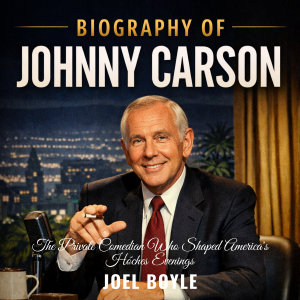
BIOGRAPHY OF JOHNNY CARSON
Joel Boyle
This audiobook is narrated by a digital voice.
He didn’t raise his voice. He didn’t chase attention. Yet for three decades, he held a nation in the quietest grip imaginable.
Biography of Johnny Carson: The Private Comedian Who Shaped America’s...
Location:
United States
Description:
This audiobook is narrated by a digital voice. He didn’t raise his voice. He didn’t chase attention. Yet for three decades, he held a nation in the quietest grip imaginable. Biography of Johnny Carson: The Private Comedian Who Shaped America’s Evenings is not just the story of a television legend—it’s the story of how control, discipline, and precision built one of the most powerful careers in entertainment history. From a boy performing card tricks as “The Great Carsoni” in small-town Nebraska… to a Navy serviceman learning composure under pressure… to a broadcaster who mastered the art of timing, Carson didn’t stumble into greatness. He built it—step by step, skill by skill. This audiobook takes you beyond the spotlight and into the structure behind the man: The Tonight ShowBut this is also the story of a man who stayed just out of reach. Private. Controlled. Measured. While the world laughed, Carson revealed only what he chose. And that mystery became part of his power. If you’ve ever wondered what truly makes a performer unforgettable—or how influence is built without noise—this audiobook gives you a rare, clear answer. This isn’t hype. This is structure. This is craft. And this is the man who made late night feel like home. Start listening now and discover the quiet force behind one of television’s greatest icons. Duration - 2h 1m. Author - Joel Boyle. Narrator - Digital Voice Madison G. Published Date - Saturday, 17 January 2026. Copyright - © 2026 Joel Boyle ©.
Language:
English
OPENING CREDITS
Duration:00:00:12
Johnny Carson: a connected explanation of his life and impact
Duration:00:00:44
Early life: performance as discipline, not noise
Duration:00:00:58
Military service: structure, responsibility, and emotional economy
Duration:00:00:44
University and early broadcasting: learning the job from the ground up
Duration:00:00:42
The jump to national television: from performer to host
Duration:00:00:57
The Tonight Show: why his style lasted
Duration:00:01:14
West Coast move and workload changes: power and longevity
Duration:00:00:51
Characters and comedy: controlled silliness as a trademark
Duration:00:00:40
Public controversies: influence can create real-world effects
Duration:00:00:52
Retirement, final show, and the “quiet exit”
Duration:00:00:32
Honors and recognition: how institutions measured his impact
Duration:00:00:52
Philanthropy: a different kind of legacy
Duration:00:00:52
Final years and death: health, smoking, and closure
Duration:00:00:37
What his influence actually looks like
Duration:00:00:58
Chapter 1
Duration:00:00:03
Roots: Iowa Birth, Nebraska Boyhood, and The Great Carsoni
Duration:00:09:32
Chapter 2
Duration:00:00:03
War Service: Navy Training, USS Pennsylvania, and the Cost of Duty
Duration:00:00:52
Enlistment and the V-12 program: learning the officer mindset
Duration:00:01:13
Assigned to the USS Pennsylvania: stepping into the Pacific reality
Duration:00:01:10
Damage control work: the darker side of “just doing your job”
Duration:00:01:32
Performing magic during service: keeping control, keeping morale
Duration:00:01:04
The Forrestal moment: performing for someone who doesn’t need to be impressed
Duration:00:01:12
Boxing record: controlled aggression, controlled fear
Duration:00:01:11
The cost of duty: what he carried forward
Duration:00:01:14
Chapter 3
Duration:00:00:03
Education and Craft: University of Nebraska and Learning Comedy as a Skill
Duration:00:01:09
The major change: choosing speech and drama over a safer route
Duration:00:01:41
Why radio and speech training matters for late-night television
Duration:00:01:04
Comedy-writing thesis: treating humor like a system
Duration:00:02:44
Graduating fast: skill, focus, and urgency
Duration:00:00:59
Early professional direction: stepping into broadcasting with a toolkit
Duration:00:01:27
The deeper meaning of this chapter: why Carson didn’t “wing it”
Duration:00:01:39
Chapter 4
Duration:00:00:03
Omaha to Los Angeles: First Broadcasting Jobs and the Break into TV
Duration:00:00:55
● Omaha: learning to perform for real people, not an imagined audience
Duration:00:02:10
● Early satire and local politics: learning what you can say, and how to say it
Duration:00:02:09
● The path to Los Angeles: how opportunity often arrives through someone watching you
Duration:00:01:38
● KNXT and momentum: why Los Angeles was a different kind of pressure
Duration:00:01:38
● What this chapter reveals about the “Carson formula”
Duration:00:01:19
● Why “gaining momentum” matters more than a single breakthrough
Duration:00:01:19
Chapter 5
Duration:00:00:03
Writers’ Rooms and Live Pressure: Red Skelton, Jack Benny, and Early Hosting
Duration:00:00:39
The writer’s room: learning how jokes are built, not just told
Duration:00:01:38
Stepping in on-air: the kind of pressure that reveals character
Duration:00:01:21
Influence and apprenticeship: Jack Benny and the art of restraint
Duration:00:01:43
Early hosting: learning how to carry a program, not just appear on one
Duration:00:01:25
Panelist work: learning conversational quickness without control of the script
Duration:00:01:24
The deeper pattern: Carson was becoming “useful” to television
Duration:00:00:54
Why this chapter matters to his later legacy
Duration:00:00:54
Chapter 6
Duration:00:00:03
Daytime Mastery: Who Do You Trust? and the Partnership with Ed McMahon
Duration:00:00:53
Moving to New York: stepping into the center of the business
Duration:00:01:13
The ABC era: why Who Do You Trust? mattered
Duration:00:01:30
Interviewing and ad-libbing: making quick thinking look natural
Duration:00:00:21
1) Listen while preparing the next move
Duration:00:00:24
2) Keep the rhythm moving
Duration:00:00:26
3) Ad-lib with control
Duration:00:00:22
4) Create comfort without losing authority
Duration:00:00:50
Developing his on-camera identity: the birth of “Carson energy”
Duration:00:00:56
Meeting Ed McMahon: chemistry built on function
Duration:00:01:28
The “straight man” dynamic: why it made Carson stronger
Duration:00:00:18
1) It creates rhythm
Duration:00:00:11
2) It gives the audience a guide
Duration:00:00:15
3) It gives the host space
Duration:00:00:23
Why daytime didn’t shrink him—it sharpened him
Duration:00:01:32
Chapter 7
Duration:00:00:03
Becoming the Host: Taking Over Tonight and Building the Carson Format
Duration:00:01:30
NBC’s search: finding someone who could last
Duration:00:01:53
The guest-host era: the show in limbo, the audience watching closely
Duration:00:01:26
October 1962: the debut that looked easy later, but wasn’t easy then
Duration:00:01:29
Building the Carson format: the structure that made him powerful
Duration:00:00:48
The monologue: a nightly reset
Duration:00:00:36
The desk: control without intimidation
Duration:00:00:34
The partnership: Ed McMahon as an anchor
Duration:00:00:39
The interview style: conversation guided by timing
Duration:00:00:42
Recurring bits: familiarity as comfort
Duration:00:00:29
The emotional truth of the early hurdles: why the first year mattered
Duration:00:00:53
Why NBC got what it wanted—and why America stayed
Duration:00:01:03
Chapter 8
Duration:00:00:03
The Machine Behind the Magic: Production, Burbank Move, Schedule Changes, and Power
Duration:00:00:43
New York to Burbank (1972): why the move changed more than geography
Duration:00:01:56
Schedule changes: why Monday guest hosts became a symbol of leverage
Duration:00:01:24
Rotating hosts: a controlled experiment disguised as variety
Duration:00:00:48
Theme song and royalties: how a signature sound became money
Duration:00:01:08
Show structure solidifies: why repetition is not laziness
Duration:00:01:02
Salary growth and NBC leverage: when a host becomes a profit center
Duration:00:01:16
The “uncensored satellite feed” era: when technology cracked the illusion
Duration:00:01:48
What this chapter proves about Carson’s power
Duration:00:01:24
Chapter 9
Duration:00:00:03
Icon, Comedy Lab, and Culture Shaper: Characters, Moments, and Public Impact
Duration:00:00:47
The signature characters: comedy as a tool for mood control
Duration:00:00:33
Carnac the Magnificent: the perfect “controlled chaos”
Duration:00:01:00
Art Fern: parodying American selling and the comedy of speed
Duration:00:00:49
Aunt Blabby and Floyd R. Turbo: using exaggeration to expose attitudes
Duration:00:00:57
The Uri Geller episode: when skepticism became television history
Duration:00:01:35
The show as a launchpad: why Carson became the gatekeeper comedians dreamed of
Duration:00:01:32
Cultural ripple effects: when a joke becomes a real event
Duration:00:00:13
The toilet paper panic: the power of a trusted voice
Duration:00:00:45
Twister: when entertainment becomes marketing by accident
Duration:00:00:43
Awards and honors: institutional proof of significance
Duration:00:01:04
Why Chapter 9 is the heart of the legacy
Duration:00:01:08
Chapter 10
Duration:00:00:03
The Private Man and the End of an Era: Marriage, Loss, Retirement, Philanthropy, Death, Tributes
Duration:00:00:37
Off-camera temperament: the quiet man behind the desk
Duration:00:01:32
Marriages and family life: love, instability, and the cost of being “the public man”
Duration:00:01:15
The loss of his son Ricky (1991): the moment the mask cracked
Duration:00:01:35
Retirement (May 1992): stepping away while still on top
Duration:00:01:24
Rare appearances: the power of refusing to be everywhere
Duration:00:01:02
Health decline: heart attack, emphysema, death (January 2005)
Duration:00:01:00
Tributes: why Letterman’s response mattered most
Duration:00:00:58
Philanthropy: the part of his legacy that doesn’t need applause
Duration:00:01:07
Awards and honors: recognition across entertainment and national life
Duration:00:00:51
The end of an era: what remains after the lights go off
Duration:00:01:17
CLOSING CREDITS
Duration:00:00:21