
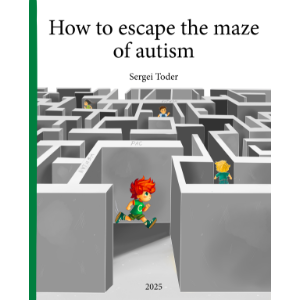
How to Escape the Maze of Autism and ASD
Sergei Toder
This audiobook is narrated by a digital voice.
“How to Escape the Maze of Autism” is not just a book — it’s a practical guide and a fresh perspective for parents, therapists, and professionals working with children on the autism spectrum.
Over the...
Location:
United States
Networks:
Sergei Toder
Digital Voice Adam E
Restoring the Body, Freeing the Mind
Sergei Toder Press
English Audiobooks
INAudio Audiobooks
Description:
This audiobook is narrated by a digital voice. “How to Escape the Maze of Autism” is not just a book — it’s a practical guide and a fresh perspective for parents, therapists, and professionals working with children on the autism spectrum. Over the past ten years, the author — motor development specialist Sergei Toder — has worked with children diagnosed with ASD and developmental delays. What he discovered changed everything: most manifestations of “autism” are not rooted in the brain. The real issues begin with the body’s biomechanics, the ribcage, and dysfunctions of the respiratory system. This book reveals how spinal, diaphragmatic, thoracic, and postural dysfunctions lead to sensory chaos, anxiety, behavioral difficulties, and delayed speech. Through a unique biomechanical approach based on movement and breathing, How to Escape the Maze of Autism offers: – A clear explanation of the true causes behind motor and behavioral issues – Practical breathing and movement exercises to help bring the child back into their body – A step-by-step program to restore natural movement patterns and healthy respiration This book is especially useful for: – Parents of children with ASD – Physical therapists, speech therapists, occupational therapists – Educators, adaptive PE instructors, and anyone committed to helping exceptional children through movement and breath If you’re tired of empty diagnoses and ineffective treatments — this book will show you a new path. A path that begins with the body, not with labels. Duration - 6h 52m. Author - Sergei Toder. Narrator - Digital Voice Adam E. Published Date - Sunday, 26 January 2025. Copyright - © 2025 Sergei Toder ©.
Language:
English
How to Escape the Maze of Autism and ASD.docx
Duración:00:00:36
Introduction
Duración:00:05:20
Introduction
Duración:00:05:17
Looks like we’ve got a new kid — and he’s Autistic.
Duración:00:07:17
IV Zones of information processing:
Duración:00:00:33
Chapter 1. Auditory processing and language skills: how we perceive, absorb, and express information.
Duración:00:04:11
Inhalation
Duración:00:02:20
And now, one last crucial fact about inhalation:
Duración:00:00:40
Exhalation
Duración:00:01:19
Attention!
Duración:00:02:42
So what’s the cause of the missing inhale — and, as a result, the shortened, dysfunctional exhale — in extraordinary children?
Duración:00:02:08
1.1 The breathing function — one of the body’s most vital.
Duración:00:12:09
1.2 The mechanism of cellular oxygen supply.
Duración:00:05:14
1.3 Diaphragmatic innervation.
Duración:00:00:48
How is the diaphragm innervated?
Duración:00:03:28
Under normal conditions:
Duración:00:02:00
1.4 Causes and consequences of diaphragmatic spasm.
Duración:00:22:10
So, we smoothly approach the main topic of our “issue”:
Duración:00:00:03
1.5 Deficit of cerebral blood supply.
Duración:00:11:32
Sensory NONintegration: How to escape the maze of Autism and ASD
Duración:00:08:24
Chapter 2. Motor planning and the execution of sequential movements and actions. Part 1
Duración:00:57:14
Chapter 2. Motor planning and the execution of sequential movements and actions. Part 2
Duración:00:20:45
Chapter 3. The third zone of information processing.
Duración:00:13:28
Chapter 4. Sensory modulation – the fourth zone of information processing.
Duración:00:12:20
4.1 Muscles of inhalation and exhalation.
Duración:00:12:44
4.2. Muscles and their distinctive characteristics.: Restorative exercise program for children with Autism and ASD.
Duración:00:33:30
4.3 Diaphragmatic breathing.
Duración:00:04:43
Chapter 5. Diagnostics, multidimensional assessments, and human posture.
Duración:00:14:15
5.1 Diagnostics.
Duración:00:07:04
Block number 2:
Duración:00:01:07
Block number 3:
Duración:00:08:42
5.2 Diagnosis of rotational subluxation of the atlas (C1 Vertebra).
Duración:00:08:27
5.3 Inspection from the front (Frontal plane).
Duración:00:04:01
Sagittal plane.
Duración:00:04:06
Head position
Duración:00:03:52
5.6 Forward bend examination (Horizontal plane)
Duración:00:00:54
5.7 Measurement of chest circumference.
Duración:00:01:21
5.8 Determining pelvic position.
Duración:00:01:08
Chapter 6. Differential diagnosis of various types of postural disorders.
Duración:00:00:20
6.1. Slouched posture.
Duración:00:00:57
6.2. Scoliotic posture in children with ASD.
Duración:00:00:31
6.3. Scoliotic disease.
Duración:00:00:42
6.4. Osteochondrosis with scoliotic manifestations.
Duración:00:00:38
Chapter 7. Strategy for postural deformity correction.: 7.1. A note for parents of children with ASD and Autism.
Duración:00:06:11
Chapter 8. Assessment of the functional state of the musculoskeletal system and physical development indicators in children with ASD.
Duración:00:02:27
Chapter 9. Regulation of motor activity.
Duración:00:05:16
Chapter 10. Instability and mobility of different sections of the spine.
Duración:00:00:05
10.1. Instability of the cervical spine.
Duración:00:01:40
10.2. Cervical spine mobility.
Duración:00:00:38
10.3. Lumbar spine mobility.
Duración:00:00:02
Assessed as follows:
Duración:00:00:31
Chapter 11. Therapeutic physical training for respiratory diseases.
Duración:00:08:18
Chapter 12. A deficiency of molecular and atomic oxygen equals a biological catastrophe for the human body.
Duración:00:08:36
Chapter 13. Dehydration in children with autism and ASD. Water-salt absorption in the human body.
Duración:00:11:04
Afterword
Duración:00:00:17
Practical guide
Duración:00:00:01
Diaphragmatic breathing
Duración:00:00:51
Chest breathing
Duración:00:00:22
Full breathing
Duración:00:00:28
Special dynamic breathing exercises.
Duración:00:09:25
Associated patterns.
Duración:00:03:55
Exercises for the correction of longitudinal and transverse flatfoot in various starting positions.
Duración:00:03:51
Target area: the back and chest.
Duración:00:02:47
Lumbosacral area massage using the nephropathy method (for younger school-aged children)
Duración:00:03:55
Glossary
Duración:00:11:08
List of references
Duración:00:00:31
Testimonials
Duración:00:07:42